Stanley "Spike" Glasser
1926 - 2018

Early Years
-
Born in Johannesburg, South Africa: 28 Feb 1926: lived in the suburb of Yeoville at 28 Webb Street.
-
Parents Joe and Asia Glasser had emigrated from Vilnius, Lithuania circa 1910.
-
Grandparents only seen once when he was less than 2 years old, on the only visit back to Vilnius.
-
Younger brother Mervin 'Chips' Glasser.
-
Cycled on his own, without permission, to the Johannesburg Zoo by tricycle when he was a very small child.
-
As a young child was taken to Zebediela [near Petersberg]. where he had fond memories of riding donkeys with African children in the orange orchards.
-
Also went on a trip to a family friend who had a sweetshop and often told the anecdote where he went in innocently and began to help himself to lots of bars of chocolates and sweets when the owner came in and gently suggested he take just one and eat that first.
-
His father, who played the violin & loved music, would stand him by the wind-up record player [with large listening horn] to listen to classical music.
-
Went to King Edward School in Johannesburg.
-
Learned piano from c. 4-5 years old.

Adolescence
-
Played rugby at school and was also a runner, which is how he got his nickname 'Spike' from running shoes with spikes.
-
He was a talented, precocious classical pianist who practised every morning before school and studied with Isador Epstein and Adolf Hallis [two of Johannesburg’s top piano teachers]. In later life, although he still played very efficiently, he absolutely hated playing in front of people.
-
Stanley tells of a recital he had to give in school where he did not like the tame piece he had been told to play and instead substituted at the last minute for Debussy’s ‘Cakewalk' which caused his teachers to reprimand him.
-
In his mid-teens, on Friday nights, he taught young Africans to read, write and do arithmetic, after which he would join other teachers [all much older than he] to go to the local dance hall & listen to African vocal groups performing.

YOUNG ADULTHOOD
-
As a young student, he visited a farm in the Cape called Laurenceford, which made a deep impression on him.
-
Spent time out in the Natal hills at the home of Shikelela [his father’s man servant]. Told of the story of Shik’s grandmother eating watermelon & storing the pips in her cheek until the end, when she spat them all out of her mouth like a machine –gun! He was much impressed by the technique.
-
Took an Economics degree at Wits [1949] and was very involved in student social activities. Also composed music for theatre productions and became friends with Leon Gluckman, who was one of ‘The Berts’. His closest friends were ‘The Berts’ who called each other Bert [as a joke]; they were Percy Cohen, Adolf Wood, Arnold Kentridge, Sydney Brenner and Stanley Dorfman [who was Chips' contemporary at Wits.], Leon & Mick Gluckman.
-
1950 -55; studied composition under Benjamin Frankel & Matyas Seiber.
-
1951: attended his first ISCM festival in Frankfurt.
-
1954 -55: Spent time with Hugh Tracey [the first person to begin recording & studying the music of southern Africa] learning about South African folk music, at ILAM [the International Library of African Music].
-
Decided that he wanted to become a composer. His father, Joe, came overseas with him initially in the early 50s.
-
He married Mona Schwarz in 1951 in London; marriage dissolved in 1965.
-
Stanley spent some time with Mona in Brittany, France composing and deciding he definitely wanted to compose seriously.
-
1952: Royal Philharmonic Society prizeman.
-
In 1955 someone suggested that he contacted William Walton, who was impressed by Stanley's talent and wrote a reference which got him into Cambridge University as a mature student. He went there with his then wife Mona and completed a music degree at Kings Cambridge – son, Adam, born September 1955 and daughter, Sue, born in December 1957 in Cambridge.
-
He achieved a first at Cambridge & won an award [1958]. George Richards prize awarded in 1958 for academic distinction. MA in 1960.
-
While at King’s, he was in the 1st XV rugby team & also the Gentlemen’s Eight rowing crew.
-
1958 – 60: he moved back to Cape Town and was a university lecturer at Cape Town University, becoming the assistant director of music to Eric Chisholm. He was also a music critic for The Cape Times.
-
Lived first by the sea in Muizenberg and then at Laundry Cottage Durban Rd, Cape Town.
-
In 1959 he became the music director of the first South African musical, King Kong. He spent time in Johannesburg arranging the music with South African musicians; much copying done at 28 Webb St in the flat, which had been built at the back of the house above the garage.

-
King Kong had a successful run in SA from around 1959 then there was a pause while the production was put together for an overseas run. It left Johannesburg in Feb 1961 [Adam was at the airport to see them off aged 6]. Stanley also wrote the music for The Emperor Jones by Eugene O’ Neill & directed by Leon Gluckman.
-
1962-68: Wait A Minim was a successful revue, directed by Stanley’s friend, Leon Gluckman and starred Andrew & Paul Tracey, and Jeremy Taylor. It ran in S. Africa, London and New York, amongst other places. In the Broadway production, Stanley contributed one song: Skalo-Zwi.
-
Around 1962-1963 had the idea for the musical 'Mr.Paljas' in Cape Town and gathered together a team of people to do it which included his student at UCT Chris McGregor who turned out to be one of the most influential and significant jazz musicians of the era, and the band also included Dudu Pukwana (saxophonist who later led a band in London called Zila and with whom Adam played 1985 - 1986)

MIDDLE YEARS
-
In 1963, Stanley came to the UK [permanently as it turned out].
-
1964 - 98: With his S. African friends, who lived in the UK, he set up The Rand Educational Fund [R.E.F.]. Annually, the contributors put in whatever each could afford. They would meet to decide how & where their money would support children educationally in S. Africa. Eventually, through contacts, they settled on helping one school in the Northern Transvaal – Kgokong School. They helped variously by supporting a teacher’s salary; by funding a fence so vegetables could be grown; funding drilling a well to find water. They also sent books and much else besides.
-
On arriving in the UK, he wrote a good deal of ‘mood music’ & music for TV, whilst also teaching adult evening classes of music appreciation for the Workers’ Educational Association [WEA].
-
In 1963 he became an evening lecturer at Goldsmiths’ College.
-
In September 1966 Stanley became a full-time music lecturer at Goldsmiths’, teaching in that first year, Liz.

-
In 1969 Stanley became head of department & in 1990, once Goldsmiths’ officially became a school of the university, he became the first professor of music there. He was to remain there until his retirement in 1991, when he became the first Emeritus Professor of Music.
-
As a result of his organising skills, the music department of Goldsmiths’ College became one of the most sought-after places to go to study music; it was buzzing with musical creativity.
-
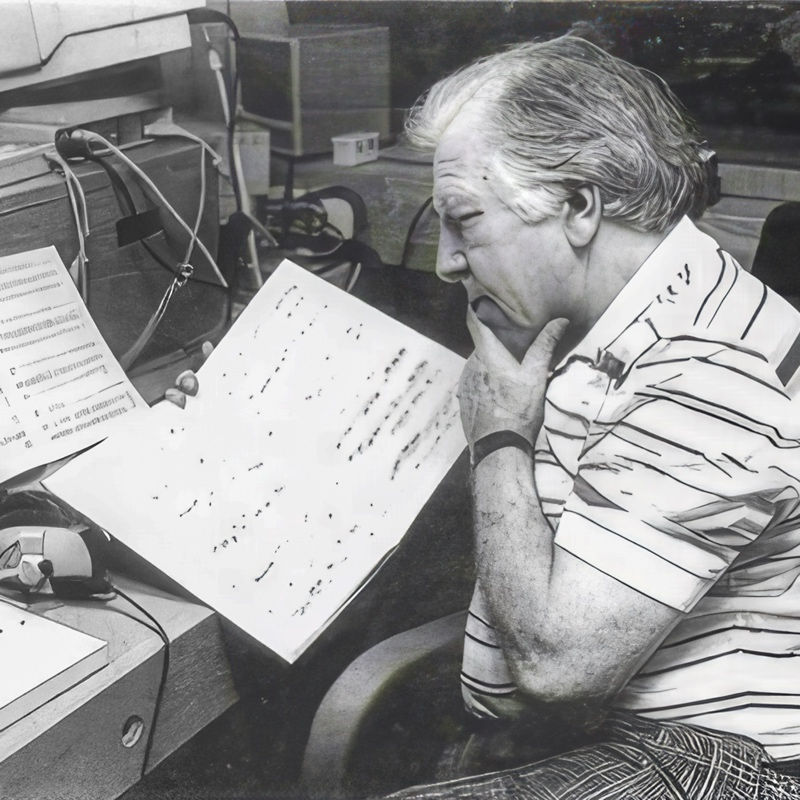
1971: Stanley established the first electronic music studio in a British university. He often invited composers to come & discuss their music & hosted many an evening’s entertainment afterwards.
-
In August 1971 he married Liz.
-
On 2 July 1972, Daniel was born.
-
On 24 November 1973, Simon was born.
-
Dec 73/ Jan 74 Adam came to live with Stanley & Liz while studying for his ALs.
-
Jan – May 1975, Stanley, Liz & the boys went to SA, where S & L undertook folk music research in the northern Transvaal, based in Pietersburg [now Polokwane].
-
From 1976 almost every summer has been spent in Juillac, Dordogne, a place found by chance & loved immediately. Each morning, Stanley would run down into the valley & up again, & then do exercises. The boys were to join him on the morning exercise routine in the course of the years. But not Liz!

-
During the summer holidays, he would compose every morning. Composition took place during the year too but was constantly interrupted by university matters.
-
Christmas 1981 – January 1982: a return to SA to study folk music in the Transkei.
-
1981-83, he was the chairman of the Board of Studies in Music, University of London.
-
Also, amongst much else: external examiner at universities and music colleges around the UK; 1981-83 composer-in-residence at Standard Bank National Arts festival, S. Africa; 2001 member and treasurer of the International Committee for Traditional Music [ISCM]; 1980 – 2011 Academic governor, Richmond, American International University in London; chairman of The Composers’ Guild of GB; trustee, Classic FM Charitable Trust and also broadcaster; contributor to the New Grove Dictionary of Music [6th edition].

LATER YEARS
-
August 1991, retirement from Goldsmiths’.
-
He was made an Emeritus Professor of Music & given an Honorary Fellowship of Goldsmiths’ College.
-
In his time at Goldsmiths’, he became Dean of the Arts faculty & also Dean of Music for the whole of the University of London 1985-89 – someone cracked the joke that he was ‘duodenal’.
-
In these capacities, he met the Queen Mother on several occasions & Princess Anne.
-
Anecdote: on one occasion, in the Queen Mother’s presence, over tea & cakes, Stanley [always knowing how to empathise with people] told the QM how successful Princess Anne [her granddaughter] was in the job she had taken over from the QM [ie Chancellor of the University]. As they chatted away, the QM found out that Stanley had two small boys. She immediately cut up 2 pieces of cake for S. to take home to D & S. To Stanley’s disappointment/surprise the boys were not so keen to hear about the QM but more keen just to eagerly eat the cake!
-
From 1994 - 2002 Stanley became involved in the opening years of Classic FM. During that time, he hosted & wrote a programme called ‘The A to Z of Music’. It was very successful. He wrote a book to accompany the series.
-
Also, in the 1990s & 2000s, through one of his colleagues [a bass singer] he became acquainted with St. George’s Chapel, Windsor. This began a fruitful time of composing for the choir. Stanley met The Queen there & watched her tapping her feet in time to his music during a performance!
-
Throughout his ‘retirement’ he worked ceaselessly: undertaking postgraduate students; being involved in the folk music society of GB; as a governor for Richmond University; a music consultant for many educational establishments. He was constantly composing.
-
In 2002 Stanley wrote Celebration Dances for HM The Queen’s Golden Jubilee concert at St George’s Chapel, Windsor.
-
Hobbies, as such, he never had: regularly composing was a necessity, not an add-on.
-
He exercised all his life, until Spring 2013. Shingles in 2009, which lasted a year, put paid to his composing.

-
His enjoyments in life, outside his professional activities, have been his ever-increasing family, dining with friends, theatre & concert-going, films [with an especial penchant for cowboy films].
-
He could speak either fluently or enough to be understood: English, Afrikaans, Zulu, French, German.
-
Never a practical man, unlike his father [who, amongst much else, built Wendy houses!], Stanley’s cooking & gardening skills were very limited – mostly to telling other people how to do whatever it was!
-
By 2013, his Alzheimer’s, which had slowly progressed mostly unnoticed by us all, had taken over. In December 2013 he went into a nursing home, Meadows, where he was cared for wonderfully. Liz visited him daily, feeding him, shaving him and playing him recordings of his music.
-
Stanley died peacefully, on August 5th 2018, early in the morning.